
Best Rental Websites in Canada: A Newcomer Family’s Guide to Finding a Home
If you landed in Canada less than six months ago and have no Canadian credit history, the standard ranking of the best rental websites in Canada does not apply to you. Most guides rank platforms by listing volume.
For a newcomer family, that is the wrong filter. The question is not which platform has the most listings, it is which platform gives you the best chance of being taken seriously by a landlord before you have a Canadian rental history, a credit score, or local references.
The Newcomer Rental Platform Stack
Tier 1 — Build your credibility first: liv.rent. Create a verified tenant profile here before you contact any landlord anywhere. It is free, it can be done before you land in Canada, and it gives you something concrete to present instead of an empty rental history.
Tier 2 — Find flexible landlords: Kijiji. Private landlords here are more open to employment letters, bank statements, and references in place of a formal credit check. Screen every listing carefully; the verification checklist later in this article tells you exactly how.
Tier 3 — Research the market: Rentals.ca and PadMapper. Use these to understand what rent actually looks like in your target city and neighbourhood before committing to any search platform as your primary tool.
This article covers every platform in detail: what each one is built for, who runs the listings, and what to watch out for. If you are short on time, start with Tier 1.
Canadian Rental Platforms Compared
Not every platform works at every stage of your Canadian rental journey. The columns below are built for newcomer families, not for someone who has already been renting in Canada for years.
| Platform | Credit History Required | Scam Risk | Best Stage to Use |
|---|---|---|---|
| liv.rent | No | Low | 0–3 months in Canada |
| Kijiji | No | Medium | 0–12 months |
| Rentals.ca | Flexible | Low | 0–12 months |
| Realtor.ca | Yes | Low | 3 months+ |
| Zumper | Flexible | Low–Medium | 3 months+ |
| PadMapper | No | Low | Any stage research tool |
| Facebook Marketplace | No | High | 12 months+ only, with caution |
The sections below cover each platform in more detail. If you are short on time, start with liv.rent.
What Rent Actually Looks Like Right Now
Before you decide where to search, know what rent looks like in your target city.
As of September 2026, average asking rents for a one-bedroom unit across the Greater Toronto Area are:
- Toronto: CAD2,399/month
- Brampton: CAD1,779/month
- Oshawa: CAD1,603/month
If your household budget is under CAD1,800/month, use PadMapper to check Brampton and Oshawa before narrowing your search to Toronto. You will find more listings, face less competition, and be in a stronger position when it comes time to apply.
Worth knowing: Approximately 70% of newly built Toronto buildings are currently offering one to two months of free rent as a move-in incentive. If you are viewing a unit in a building completed after 2022, ask the leasing team directly whether any promotions are available. Most families who know to ask receive them.
Before you get to that conversation, make sure you know what to check at viewings so you can assess the unit fully while the landlord is still present.
Canadian Rental Listing Terms You Need to Know
Before you start searching, it is worth knowing that Canadian rental listings use terminology that does not always translate directly, even for fluent English speakers. These are the terms you will encounter most often.
Hydro — Electricity. When a listing says “hydro not included,” you pay your electricity bill separately. The term comes from hydroelectric power and is used across Canada.
Bachelor unit — A studio apartment: one open-plan room serving as bedroom, living room, and kitchen, with a separate bathroom. Also called a “studio” or “bachelor apartment.” A two-bedroom unit is the minimum most families with children will need.
Den — A small enclosed room that is not a full bedroom. Usually lacks a proper window or closet. Listed as a feature (e.g. “one bedroom plus den”) because it can serve as a home office, but it is not a sleeping room.
Ensuite laundry — A washer and dryer inside the unit. Different from “in-building laundry,” which means shared machines in a common laundry room, often coin-operated and booked around other tenants.
First and last — A deposit equal to two months’ rent, typically collected at lease signing. The “last” portion is held by the landlord and applied to your final month of tenancy. Deposit rules vary by province; in Ontario, landlords can only collect a last month’s rent deposit (no damage deposit). Always confirm what you are being asked for and why. Make sure you understand exactly what you are agreeing to before you sign the lease.
Heat included — the landlord covers heating costs. Always confirm whether this means gas heat, electric heat, or both and whether hot water is included. “Utilities included” means electricity, heat, and water are all covered.
Month-to-month — A tenancy with no fixed end date, which either party can end with proper written notice. Different from a fixed-term lease (typically 12 months). Month-to-month can offer flexibility but also less security.
Worth knowing: You will sometimes see listings described as “all-inclusive.” This typically means heat, hydro, and water are included in the rent. Confirm this in writing before signing anything, what “all-inclusive” covers is not standardized.
liv.rent — Start Here
Before you open Rentals.ca, before you search Kijiji, create a profile on liv.rent.
liv.rent is a Canadian-built rental platform and the only one in this guide where you can build a verified tenant profile before you have a Canadian rental history.
That profile which includes identity confirmation, employment information, and references is what you show a landlord instead of a credit report.
Here is why this matters. Most rental platforms are search tools. You find a listing, contact the landlord, and then the landlord asks for documents you do not yet have. liv.rent reverses that dynamic. Your verified profile does the explaining before the landlord even asks.
Two things worth knowing: you can set up a liv.rent profile from abroad, before you land. And it costs nothing.
The platform also verifies landlords, which means the people posting listings have confirmed who they are. That alone removes a significant proportion of the fraudulent listings that appear on Kijiji and Facebook Marketplace.
Once you are renting, liv.rent tracks your rent payments building a Canadian rental record that you can use when applying for your next home.
liv.rent is most active in Vancouver, Toronto, Montreal, Calgary, and Edmonton. Coverage in smaller cities is growing.
Best for
- Newcomers with no Canadian rental history who need something credible to show landlords
- Families who want to reduce fraud risk when searching private landlord listings
- Anyone renting in Vancouver, Toronto, Montreal, Calgary, or Edmonton
Pros
- Verified profiles for both landlords and tenants
- Significantly lower fraud risk than Kijiji or Facebook Marketplace
- Digital lease signing using province-standard templates
- Rent payment tracking builds a Canadian rental record over time
- Profile can be created before you land in Canada
Cons
- Thinner coverage outside major cities
- Smaller total listing volume than Rentals.ca or Kijiji
- Some features require account registration
Worth knowing: liv.rent is the only platform in this guide where a newcomer family with no Canadian credit history can present a credible, verified profile to a landlord before they are even asked for references. Set it up first.

Realtor.ca
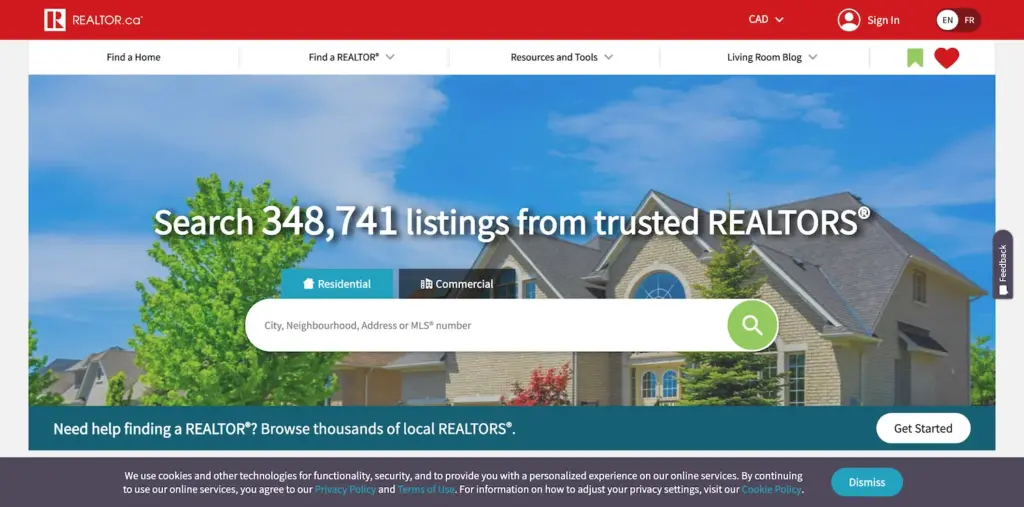
Realtor.ca is run by the Canadian Real Estate Association and draws listings from the Multiple Listing Service (MLS) – the same database that licensed real estate agents use.
It is one of the most authoritative property databases in the country, covering both rentals and homes for sale.
When you search for rentals here, you are primarily seeing listings posted by real estate agents or professional property management companies. That adds a layer of accountability that private landlord platforms do not always provide.
Best for
- Families looking for condo rentals or professionally managed units
- Renters in major urban centres — Toronto, Vancouver, Ottawa, and Calgary
- Anyone who wants to start with verified listings before expanding their search
Pros
- Backed by the MLS — listings are current and regularly updated
- Strong search filters: bedrooms, price range, pet policy, and map-based search
- Canada-wide coverage
- Listings are posted by licensed agents or professional property managers
Cons
- Private landlord listings are underrepresented
- The platform mixes for-sale and for-rent properties – you need to apply filters deliberately
- Some listings require working directly with a real estate agent
Quick Tip: When you run a search, use the “For Rent” toggle at the top of the results page. Without it, your results will include properties listed for sale alongside rentals.
Rentals.ca
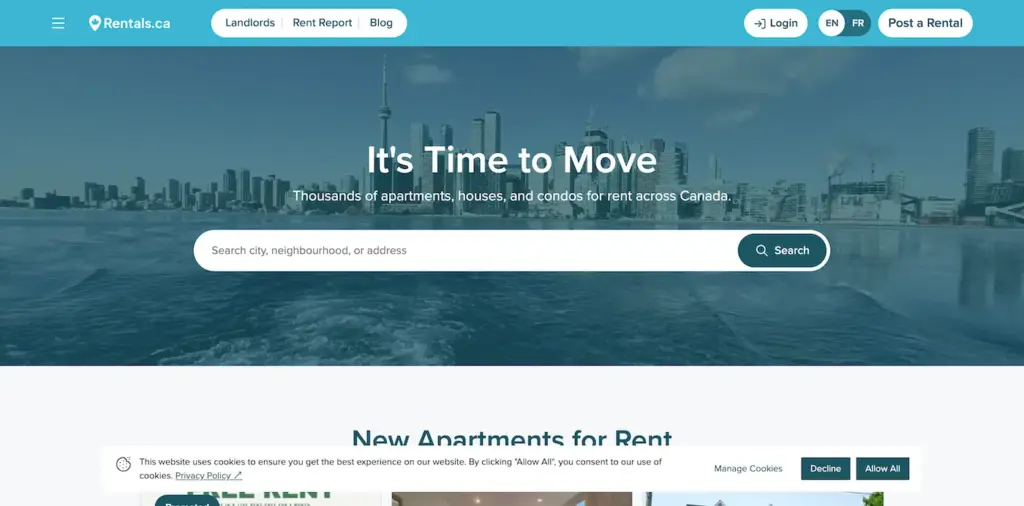
Rentals.ca is Canada’s largest dedicated rental listing platform. Every listing here is a rental, there is no need to filter out for-sale properties. That focus alone makes it a more efficient starting point if you are actively searching for a home.
The platform is used heavily by professional property management companies, which means listings tend to be current, well-described, and supported by real photos of the actual unit.
Best for
- Families searching for two- or three-bedroom units
- Renters who want professionally managed buildings with clear application processes
- Anyone who wants a rental-only platform with detailed filters
Pros
- Rental-only focus — no noise from for-sale listings
- Very high listing volume, particularly in Ontario, British Columbia, Alberta, and Quebec
- Detailed filters including pet policy, in-suite laundry, parking, and utilities included
- Professional landlords and property management companies are the primary listers
Cons
- Fewer private landlord listings than Kijiji
- Coverage in smaller cities and towns can be thin
Worth knowing: Many property management companies are accustomed to working with families who do not yet have a Canadian credit history. It is worth asking directly about their application process. Do not assume the answer is no before you ask.
Zumper
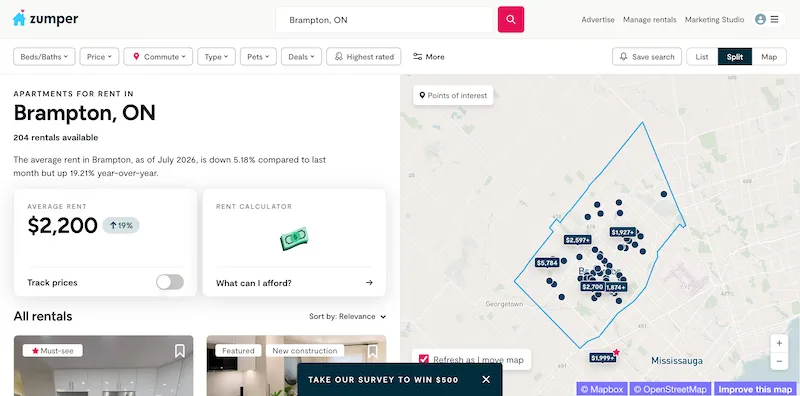
Zumper is worth knowing, particularly if your search is concentrated in Toronto, Vancouver, Ottawa, Calgary, or Edmonton. Its interface is cleaner than most Canadian rental platforms and its Instant Apply feature allows you to submit a formal rental application directly through the site on some listings.
For most newcomer families in their first six months, Rentals.ca will be a more practical starting point; it covers wider inventory and more of Canada.
Zumper becomes more relevant as your Canadian documentation builds and you are applying to professional landlords who want a fast, structured process.
Cons
- Listing inventory drops significantly outside major cities
- Smaller overall market share in Canada compared to Rentals.ca
Kijiji
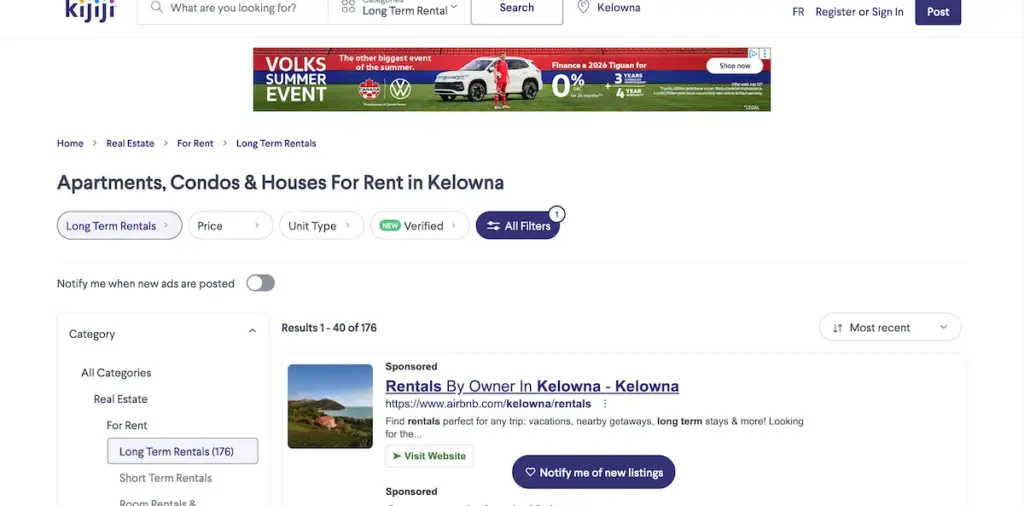
Kijiji is Canada’s largest classifieds website. It is not a dedicated rental platform, but it has become one of the most widely used spaces for private landlords to post available units, often before those listings appear anywhere else.
If a family is renting out their basement suite, or a homeowner has a unit available in a smaller building, there is a strong chance that listing appears on Kijiji first.
Best for
- Renters looking for private landlord listings
- Families open to basement apartments, smaller buildings, or units outside large property management companies
- Anyone whose credit history may not yet meet formal property management requirements — private landlords are often more flexible about alternative references
Pros
- Very high listing volume across Canada, including smaller cities and towns
- Private landlords are often open to employment letters, bank statements, or personal references in place of a formal credit check
- Free to search
- Strong presence in markets where dedicated rental platforms have less coverage
Cons
- Listing quality varies significantly
- Fraudulent listings exist and require careful screening
- Listings can become outdated — always check the post date before reaching out
- No formal application or verification process
Worth knowing: Kijiji listings are posted by individual landlords and there is no verification process. Use the 90-second checklist below before you contact anyone.
Before You Contact Any Kijiji Landlord, Do This First
Never send an e-transfer before attending an in-person viewing and signing a lease. There is no legitimate reason for a landlord to require payment before you have seen the unit.
Reverse image search every photo. Drag each listing photo into Google Images. If the same photos appear on a different listing, a real estate site, or a stock photo library, the listing is fraudulent.
Google the exact address plus the words “for sale.” A property actively listed for sale is frequently impersonated in a rental scam.
Check the post date. Any listing more than three weeks old with no price reduction is likely already rented or fraudulent. Do not invest time in it.
PadMapper
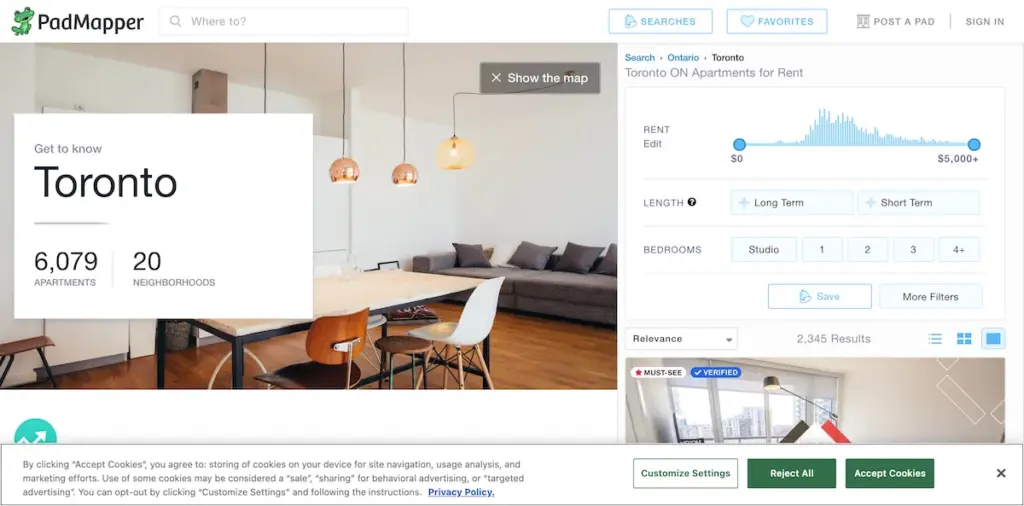
PadMapper takes a different approach from other platforms. Rather than displaying results as a standard list, it places rental listings on a map which makes it useful when you are searching by proximity to a specific school, transit station, or workplace rather than by city name alone.
The platform aggregates listings from multiple sources; PadMapper is a sister company to Zumper which means some listings may appear as duplicates from other platforms you are already using.
Best for
- Renters who want to search by neighbourhood or distance from a specific location
- Families still learning the layout of a new city
- Anyone who wants to see what is available within their budget across different areas of a city
Pros
- Visual, map-based search
- Aggregates listings from multiple platforms
- Helpful for identifying which neighbourhoods fall within your budget
- Free to use
Cons
- Duplicate listings are common — always verify on the original source platform
- Not all listings are current
- No built-in application process
PadMapper works best as a research layer rather than a primary search tool. Use it to identify which neighbourhoods have listings at your price point, then go to the original platform to apply.
Facebook Marketplace
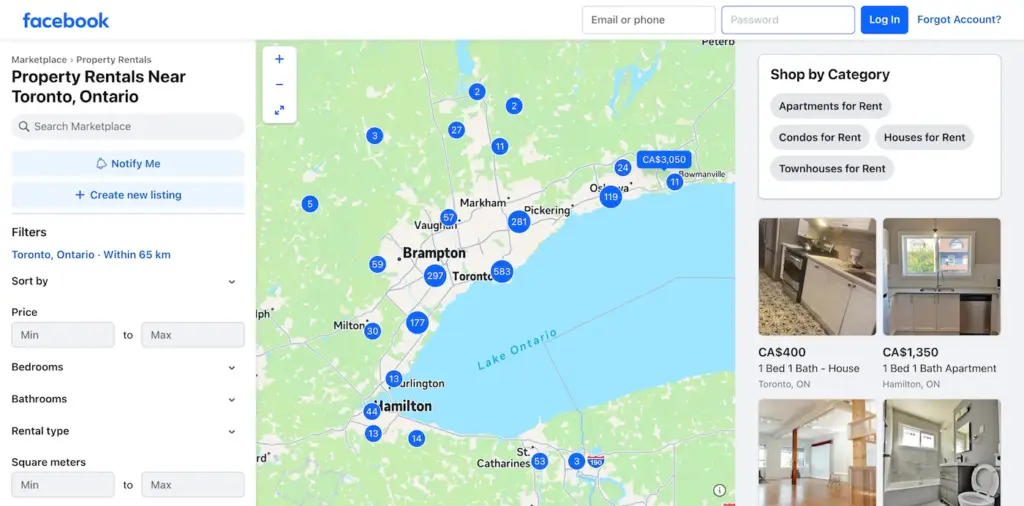
Facebook Marketplace is not a dedicated rental platform, but across Canada particularly in suburban areas and smaller cities, it has become a space where private landlords post available units quickly.
It is included here because excluding it would give you an incomplete picture. In some markets, it is genuinely active. In others, it is thin and unreliable.
The key fact to hold before you use it: in 2025, Toronto renters lost CAD2.3 million to rental scams, with an average loss of CAD1,800 per victim. Facebook Marketplace accounted for a disproportionate share of those cases.
If you have been in Canada less than six months, do not start your rental search on Facebook Marketplace. You do not yet have the pattern recognition for what a normal Canadian rental interaction looks like, and CAD1,800 is money most newcomer families cannot afford to lose in the first month.
Use it only after you have already checked liv.rent, Rentals.ca, and Kijiji. When you do use it, apply the same 90-second verification checklist described in the Kijiji section above.
Best for
- Supplementary searching in suburban or smaller markets where dedicated platforms have less coverage
- Renters who are 12 months or more into their Canadian journey and have built familiarity with how the local rental market works
Pros
- High listing volume in some suburban and regional markets
- Direct contact with landlords
- Free to use
Cons
- No verification system for landlords, listings, or properties
- Highest scam risk of any platform in this guide
- No formal application or lease management process
Worth knowing: Legitimate landlords will always want to meet you in person. They will not ask for a deposit before you have viewed the property and signed a lease. If a listing asks for payment before a viewing, or if the rent is dramatically below what similar units cost in the same area, do not proceed.
Two More Options To Explore
Property Management Company Websites
Most rental guides stop at the platforms. This channel is worth adding to your search.
Many of the larger apartment buildings across Canadian cities particularly in Ontario, British Columbia, and Alberta are managed by property management companies. These companies often list their available units directly on their own websites, sometimes before those listings appear on Rentals.ca or any other platform.
These buildings tend to have professional leasing teams, clear application processes, and defined timelines. For families managing the early months of settlement, that structure can be easier to navigate than negotiating directly with a private landlord.
To find them: search “[your city] property management companies rentals” and visit the websites of companies operating in your target area. If there is a specific building you are interested in, search the building name to find the management company’s contact details.
It is also worth asking directly whether they have experience working with families who are in the early stages of building their Canadian credit history. Many do.
Lease Assignments
One more channel worth knowing about: lease assignments. A lease assignment happens when an existing tenant transfers their remaining lease to a new tenant with the landlord’s written approval.
The incoming tenant takes over the unit and the original lease terms, usually for whatever time is left on the agreement.
For a newcomer family, this can occasionally work well. The unit is sometimes already furnished, the commitment is shorter than a fresh 12-month lease, and the outgoing tenant and landlord are usually motivated to fill it quickly.
The process is different from a standard rental application: there are additional steps, approval requirements, and things to check before agreeing to take on someone else’s lease. That is worth understanding in detail before you pursue one. We cover it fully in Lease Assignments in Canada: What Newcomer Families Need to Know.
How to Use These Platforms: A Stage-by-Stage Workflow
The right platform depends on where you are in your Canadian journey, not which site has the most listings.
Stage 1 — Just Arrived (0–3 months in Canada)
Your priority at this stage is finding a landlord who will work with limited Canadian documentation.
- Set up your liv.rent profile before you contact any landlord anywhere
- Search Kijiji for private landlord listings, using the 90-second verification checklist above
- Use Rentals.ca and PadMapper to benchmark what rent looks like in your target neighbourhood
- Avoid Facebook Marketplace entirely at this stage
Stage 2 — Building Your Canadian Profile (3–12 months)
You now have employment history, a bank account with transaction records, and potentially a Canadian reference from your first landlord. More platforms are realistic.
- Add Rentals.ca and Zumper as primary search platforms
- Contact property management companies directly — many are experienced with newcomer applications and will consider alternative documentation
- If you are paying rent through liv.rent, your payment history is building a rental record that works in your favour at the next application
Stage 3 — Established Renter (12 months+)
Your Canadian documentation is in place. You can now apply to any platform with confidence.
- All platforms in this guide are realistic options
- MLS-backed listings on Realtor.ca and professional property management companies become fully accessible
- Consider whether your current rental still fits your family’s needs — many newcomers upgrade at the 12-month mark once they have a fuller picture of the city
Every platform in this guide is free to search. If a website asks you to pay before you can browse rental listings, treat that as a red flag.
Set up email alerts on every platform you use. In Toronto, Brampton, and Vancouver, listings in the right price range can be gone within 24 to 48 hours.
Red Flags to Watch For
Rental fraud is a real problem in Canada, and newcomer families are frequently targeted because they are still learning how the local market works. These are the signs to act on immediately:
- Rent significantly below the going rate for similar units in the same area
- A landlord who will not show you the unit in person before asking for payment
- Requests to pay via e-transfer, gift card, wire transfer, or cryptocurrency before signing a lease
- A landlord who claims to be abroad and offers to mail the keys after you send a deposit
- Pressure to pay or commit before you have had time to view the unit in person
In 2025, Toronto renters lost CAD2.3 million to rental scams, with an average loss of CAD1,800 per victim. Knowing what these scams look like before you start searching is the most practical protection you have.
For a full breakdown of the specific fraud patterns used against newcomer families in Canada and exactly how to spot them read our complete guide to rental scams in Canada.
Editor’s Note: Legitimate landlords collect a deposit at lease signing, not before you have seen the unit, and not via e-transfer or cash to a stranger. If someone asks you to send money before you have met them in person, signed anything, or received paperwork, that is a scam.
Deposit rules vary by province, for instance in Ontario, for example, landlords can only collect a last month’s rent deposit, not a damage deposit. If you are unsure what you are being asked to pay and why, ask for it in writing before agreeing to anything.
Frequently Asked Questions
Is there one website with all Canadian rental listings?
No single platform captures every listing in Canada. Using two or three platforms at the same time: Realtor.ca, Rentals.ca, and Kijiji gives you the broadest coverage without overwhelming yourself.
Which rental website is the safest starting point?
Realtor.ca and Rentals.ca have the highest proportion of professionally managed, verified listings and are the safest platforms to begin your search. Kijiji and Facebook Marketplace require more careful screening.
Can I find a rental without credit history in Canada?
Many private landlords, particularly those who post on Kijiji will consider alternative references such as an employment letter, recent pay stubs, or bank statements showing available funds.
Property management companies have more formal processes, but many have experience working with families who are building their Canadian credit history. Ask directly rather than assuming the answer is no.
Are listings on Kijiji legitimate?
Many are. Kijiji is used widely by genuine private landlords across Canada. The key is applying careful screening to every listing: always view the unit in person, never pay before signing a lease, and check the post date on any listing before reaching out.
How do I search by neighbourhood on these platforms?
Most platforms allow you to enter a neighbourhood name or draw a search boundary on a map. PadMapper is the most visual tool for this. You can also enter the name of a specific street, transit station, or school and filter results by proximity.
From Searching to Applying: What to Do Next
Start with liv.rent to build your verified profile. Add Kijiji for private landlord options. Use Rentals.ca and PadMapper to understand your target market. Expand to professional platforms as your Canadian documentation builds.
Once you have a shortlist of listings, the search phase ends and the application phase begins. The families who hear back first are the ones who arrive with the right documents ready.
When you are ready to put together your first rental application, read our guide on what landlords in Canada are actually looking for: the documents, the introduction, and how to stand out when you do not yet have a Canadian rental history.
If you are still in temporary accommodation while you search, our article on temporary housing options in Canada covers what to book and how to use that time without pressure.
Before You Sign Anything: The Newcomer’s Full Renting Roadmap
Finding a listing is only step one. Here’s what every newcomer needs to
know before, during, and after renting in Canada.
- Types of Rental Housing in Canada: What Newcomers Need to Know
- Temporary Housing in Canada: Where to Stay Before You Sign a Lease
- Rental Scams in Canada: How to Protect Yourself as a Newcomer
- First and Last Month’s Rent in Canada: What You Need to Prepare
- Canadian Lease Agreements Explained for Newcomers
- First Apartment Checklist Canada: Don’t Move In Without This
- Renting in Canada as a Newcomer Family: A Complete Guide
